When purchasing colored speckles for your detergent, cleaning product, or plastic manufacturing, do you instinctively focus only on the “price per kilogram”? If so, you might be missing out on significant cost optimization opportunities that could transform your bottom line.
As a chemical raw material manufacturer specializing in high-performance colored speckles, we frequently hear feedback like: “Your speckles are indeed good quality, but they’re more expensive than ordinary products on the market.” However, when we dig deeper into these customers’ overall manufacturing costs, an interesting pattern emerges—those who ultimately choose high-concentration colored speckles actually save 15-30% on their total production costs.

This comprehensive cost-in-use analysis will unveil the true picture of manufacturing expenses and help you make procurement decisions based on rational financial analysis: The key to saving money isn’t the lowest unit price, but the lowest overall cost.
Why Unit Price Focus Leads to Hidden Losses
Traditional low-concentration colored speckles may appear attractive on the price tag, but they bring a series of easily overlooked hidden costs during production that accumulate into significant financial drains.
High Dosage Rates Directly Erode Profits
Traditional colored speckles typically contain only 10-20% pigment concentration, requiring high addition ratios of 4-8% to achieve target color depth. Let’s examine what this means in real financial terms:
Consider a detergent factory producing 100 tons of product monthly. Using traditional colored speckles with a 5% addition rate requires purchasing 5 tons of speckles per month. At a unit price of $6.25/kg (¥50/kg), the monthly procurement cost reaches $15,625 (¥250,000).
With high-concentration speckles containing 40-60% pigment, the addition rate drops dramatically to 1.5-2%. Even if the unit price is 30% higher at $8.15/kg (¥65/kg), the monthly procurement cost is only $8,125 (¥130,000)—a direct monthly saving of $7,500, or $90,000 annually.
For products requiring deeper colors where traditional speckle addition rates must reach 8-10%, the cost pressure becomes even more severe.
Dust Generation Wastes More Than Just Raw Material
Low-concentration speckles tend to generate significant dust during production and conveying. This not only pollutes the manufacturing environment and increases cleaning costs but, more importantly, causes silent loss of valuable raw materials. Industry data indicates that factories using traditional speckles experience raw material losses of 0.5-1.5% due to dust generation alone.
Additionally, dust accumulation increases equipment maintenance frequency—shorter filter replacement cycles, higher risk of conveying pipe blockages, and increased wear on moving parts. These issues translate into visible repair costs and invisible downtime losses that never appear on a simple unit price comparison.
Processing Performance Impacts Energy Consumption and Scrap Rates
High addition rates of traditional speckles can disrupt the continuity of your product matrix, leading to decreased melt flow and increased processing temperatures. A documented case study from an extrusion pipe factory revealed: after switching to traditional speckles with a 7% addition rate, the melt flow rate dropped from 10g/10min to 6g/10min. To maintain production efficiency, processing temperatures had to be raised from 180°C to 200°C, increasing monthly electricity costs by $1,000.

More seriously, high addition rates can lead to defects such as color spots and inconsistent color distribution, increasing scrap rates significantly. One blow molding factory’s experience serves as a cautionary tale: due to poor fusion from high traditional speckle addition, their scrap rate increased from 3% to 8%, resulting in over 10,000 additional scrapped products monthly with losses exceeding $1,250.
Warehousing and Logistics Costs Are Frequently Underestimated
Low concentration inherently means “use more, buy more frequently, store more.” Each production cycle requires larger procurement quantities, occupies more warehouse space, and demands more frequent material handling. These seemingly minor logistical aspects accumulate into substantial operational costs. Research demonstrates that by switching to high-concentration masterbatches, companies can reduce warehouse space requirements by 50% and packaging waste by 30%.
The Three Dimensions of Cost Savings with High-Concentration Speckles
Direct Cost Reduction Through Lower Unit Coloring Cost
High-concentration speckles achieve pigment contents of 40-60%, representing 2-4 times the coloring power of traditional options. This means using less material to achieve identical or deeper colors.
Based on actual application data from the detergent industry: after a major laundry powder brand switched to our high-concentration colored speckles, their addition rate dropped from 5% to 1.8%. Although the unit price increased by 25%, the coloring cost per unit product actually decreased by 32%—pure bottom-line improvement.
Production Efficiency Gains Through Better Processability
High-concentration speckles utilize advanced dispersion technology, ensuring pigments are uniformly distributed within the carrier and demonstrate superior compatibility with your product matrix. This technical advantage delivers three measurable benefits:
More stable material flow: Eliminates the need for frequent process parameter adjustments
Superior color consistency: High batch-to-batch repeatability reduces setup waste
Improved first-pass yield: Customer feedback indicates 3-5% average increase in first-pass qualification rates after switching to high-concentration speckles
Hidden Benefits Across Operations
The advantages extend beyond direct cost comparisons:
50% warehouse space savings: Maintain same production capacity with half the inventory
Reduced logistics costs: Fewer shipments mean lower transportation expenses and carbon footprint
Enhanced workplace environment: Dust-free production reduces cleaning labor and equipment wear
Real-World Cost Comparison: Detergent Factory Case Study
To illustrate the true financial impact, we’ve modeled a comprehensive cost comparison for a factory producing 5,000 tons of detergent annually:
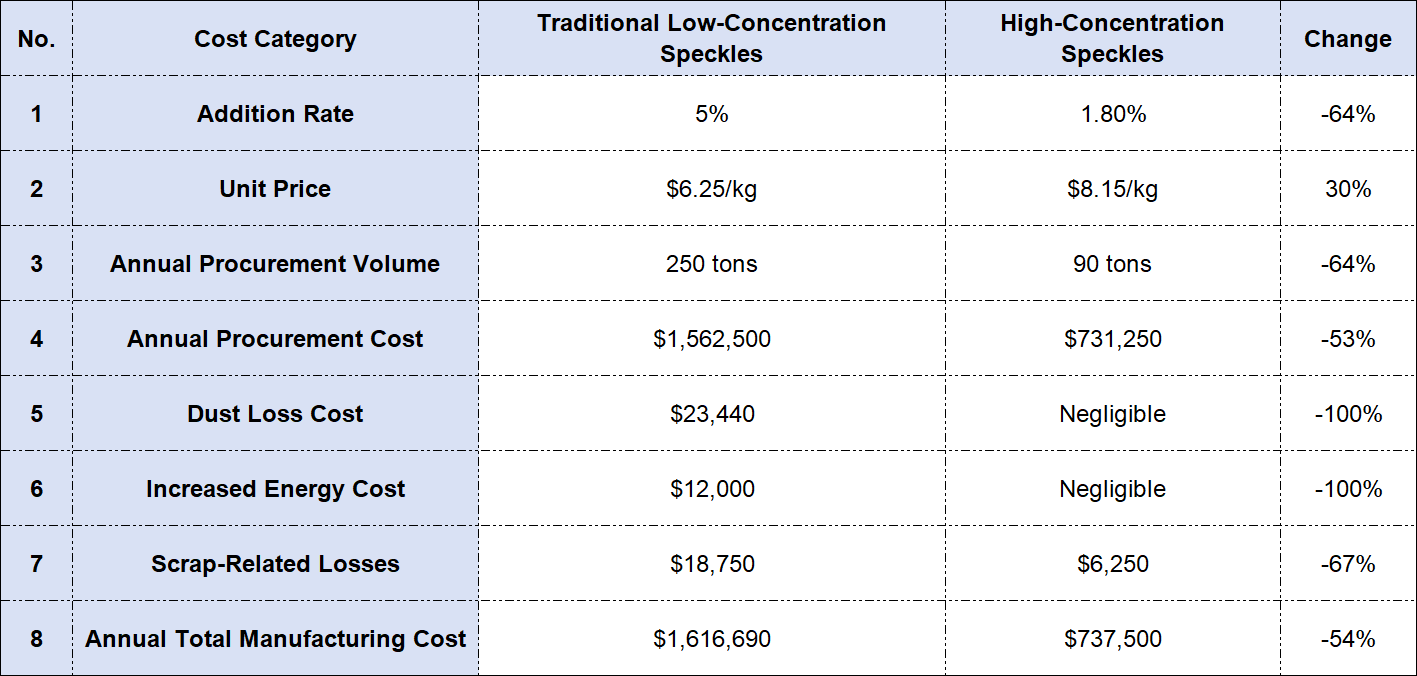
Note: Data based on industry average simulations using $1 = ¥8 exchange rate. Actual savings vary depending on specific product formulations and production conditions.
A New Procurement Mindset: Total Cost Orientation
When evaluating colored speckle suppliers for your next procurement cycle, we recommend considering these four essential questions:
What is the actual addition rate required? Don’t stop at the price tag; calculate the real addition ratio needed to achieve your target color specifications.
What impact will this product have on production efficiency? Will it increase processing temperatures, accelerate equipment wear, or require more frequent production interruptions?
How consistent is batch-to-batch color performance? Speckles with high color variation mean more setup waste, higher scrap risk, and potential customer complaints.
What technical support does the supplier provide? Professional suppliers will help optimize your addition strategy, not simply sell products—they become partners in your cost optimization efforts.
Our Commitment: Beyond Product Supply
As a professional colored speckle manufacturer with decades of formulation expertise, we deeply understand the cost pressures our customers face in competitive markets. Therefore, our technical team operates on one guiding principle: A good solution is one that demonstrably helps you save money.
What we provide extends far beyond high-quality, high-concentration speckles:
Complimentary addition rate testing: We analyze your specific products to determine optimal addition ratios for maximum cost efficiency
Production process diagnosis: Our engineers evaluate your existing workflows to identify optimization opportunities
Customized formulation development: We create proprietary speckle formulations tailored to your equipment capabilities and product requirements
Conclusion
In today’s intensely competitive manufacturing environment, every percentage point of cost optimization can determine market success or failure. Although colored speckles may appear as merely a supporting component in your product formulation, their impact on overall manufacturing costs is substantial and deserves careful analysis.
Next time you evaluate potential suppliers, challenge yourself to move beyond the “unit price mindset” and examine true costs from a comprehensive, total-cost-of-ownership perspective. We are confident that once you calculate this complete cost picture, high-concentration colored speckles will emerge as the rational, financially optimal choice for your manufacturing operations.
Ready to discover exactly how much high-concentration colored speckles could save for your specific products? Contact our technical team today to schedule complimentary addition rate testing and receive personalized cost optimization recommendations tailored to your manufacturing process.